Mount Everest is regarded as the Earth’s highest mountain. The first publicized height of the renowned Mount Everest was established by India’s Great Trigonometric Survey. This was in the year 1856 and with an estimated height of approximately 29,002 feet or 8,840 meters.
Mount Everest is regarded as the Earth’s highest mountain. It is being measured according to its summit’s height above sea level. This is actually around 29,029 feet or 8,848 meters. Aside from this, Mount Everest is also indicated as a portion of the acclaimed Himalaya range along High Asia, located just within the borders of Tibet in China and Sagarmatha Zone in Nepal.
Moreover, the first publicized height of the renowned Mount Everest was established by India’s Great Trigonometric Survey. This was in the year 1856 and with an estimated height of approximately 29,002 feet or 8,840 meters. This is amidst the fact that Mount Everest was recognized as “Peak XV” at that time. It was only during the year 1865 when it was given its official name in English as “Mount Everest”. This was implemented via the so-called Royal Geographical Society, upon the recommendation of India’s British Survey General at that time, Andrew Waugh. Since, during his time Tibet and Nepal were closed for foreigners, Andrew Waugh was not able to have a local name proposed. This is amidst the fact that the Tibetans have used the name “Chomolungma” for centuries already.
Furthermore, during the latter part of 2007 or the climbing season, the ascents towards the summit were reported to have reached approximately 3,679 by about 2,436 individuals. Due to this, there were reported cases of not more than 210 deaths in Mount Everest. In fact, the conditions were so difficult most corpses were already left as is and these corpses are often visible from the standard climbing trails.
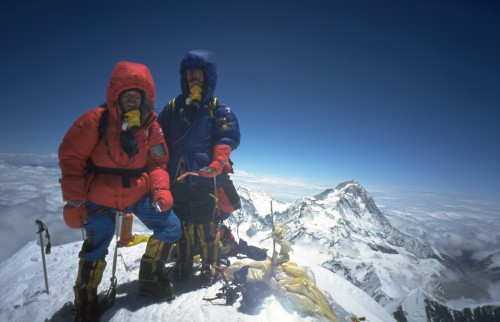
The noted climbers of Mount Everest were relative novices to experienced mountaineers. These people still count on paid guides to help them get to the top. These surges of mountaineers to the region are actually a vital tourist revenue source in Nepal. This is apart from the requirement of the government to have every prospective climber pay more or less a $25,000 per person for the permit.
Thus, Mount Everest has areas that are included in the list of Death Zones. This is because of its altitude that is above 8,000 meters or 26,246 feet. It is very difficult to actually survive in these areas. The temperature can go down to super low levels, causing frostbite to any part of the body that gets exposed in the air. Since the temperature becomes very low, snow is also frozen in particular areas, where in you can die by falling and slipping in such locations. Another potential threat is high winds as well.
Furthermore, at Mount Everest’s top part, the so-called atmospheric pressure is actually the sea level pressure’s third portion. This means that there is only a third of oxygen breathable at such sea level. Last May 2007, a certain Caudwell Xtreme Everest made a study about the oxygen levels of a person’s blood in extreme altitude. For this medical study, more than 200 volunteer climbers climbed towards the Everest Base Camp so as to be given medical tests with regards to the levels of blood oxygen in their body. Another team, a smaller group, also conducted tests while going towards the summit.
Their findings were remarkable. Even at their base camp, the very low level of oxygen was noted to have a direct effect particularly on the saturation levels of blood oxygen. The usual percentage at sea level is 98% up to 99%, however at the base camp; the percentage fell to about 85% up to 87%. Even the blood samples that were taken from the summit area featured the oxygen’s super low levels. With this phenomenon, the breathing rate vastly increased from approximately 20 up to 30 bpm or breathes per minute. Thus, it can even go as fast as 80 up to 90 bpm or breathes per minute. Climbers experienced exhaustion by merely catching their breadth. As a conclusion, exhaustion, lack of oxygen, extreme cold as well as the actual danger of climbing Mount Everest are factors that can contribute to the Mountain’s death toll.
Reports of climbers dying in Mount Everest are usually left behind. According to record, approximately 150 bodies were never recovered. In fact, when you climb the mountain, corpses are very much visible even from the standard routes.
Another discovery about Mount Everest is that amidst its very high area, lightning does not plague it. Even the Lightning Detection System of NASA was not able to get any record of lightning episodes in the Tibetan mountains that range from 7,000 feet or 2000 meters and above, only along the fascinating Tibet plateau.
Moreover, in the expeditions to Mount Everest, climbers use oxygen tanks and masks when they are above 26,246 feet or 8,000 meters. Although Mount Everest can actually be climbed even without bringing supplementary oxygen, it still increases potential risks on the climber. This is justifiable because any person that experience low oxygen levels cannot think clearly. Plus, the low temperature, severe weather and very steep slope of Mount Everest necessitate accurate and quick decision making prowess.
This is why using bottled oxygen while ascending Mount Everest has become controversial. However, many attest to using this. Even the famous George Mallory was quoted as saying that using it is “unsportsmanlike”. He later took this back when he realized it was very difficult to climb the summit without having one. He consequently used one during his climb. This was also very helpful during the initial successful summit of Hillary and Tenzing in 1953. After this, bottled oxygen has become a standard necessity for successful climbs to Mount Everest. The only dilemma, according to Jon Krauker’s book called Into Thin Air, is that with the publicity of using bottled oxygen in Mount Everest, unqualified climbers are also trying and attempting to actually summit the mountain. For Krauker, this can lead to more dangerous situations and even deaths.
Thus, last May 11th of the year 1996, such disaster occurred when 33 climbers attempted to ascend Mount Everest and leaving bottlenecks at Hillary Step. This delayed several other climbers, being unable to go with the 2:00 PM turnaround time. This caused the proposal of banning the usage of bottled oxygen while climbing Mount Everest and should only use it for severe emergency cases. This would both decrease the growth of pollution in Mount Everest and this will keep off unqualified climbers from attempting to ascend the mountain. Aside from this, the 1996 disaster brought about the issue of having a guide use bottled oxygen as well. This is because many guides of Mount Everest do not use bottled oxygen. They regard it as a “false sense of security”. The debate on this is about the inability of the guides to help their clients descend without the use of bottled oxygen.
Lastly, another issue in climbing Mount Everest is the reports about life-threatening thefts to climbers. The thefts were from the climbers supply caches. An example is an incident from the party of a certain David Sharp, where in the 1st Brazilian climber, Vitor Negrete died while descending Mount Everest. Speculations reveal that stolen supplies from his “high-altitude camp” contributed to this fatality.
Thus, Mount Everest is a very spectacular mountain. For climbers, it is an ultimate goal to actually ascend and descend it. For the rest of the world, it is a remarkable masterpiece of nature that should be nurtured and cared for.
Published At: Isnare.com Free Articles Directory - http://www.isnare.com/
Permanent Link: http://www.isnare.com/?aid=268465&ca=Travel